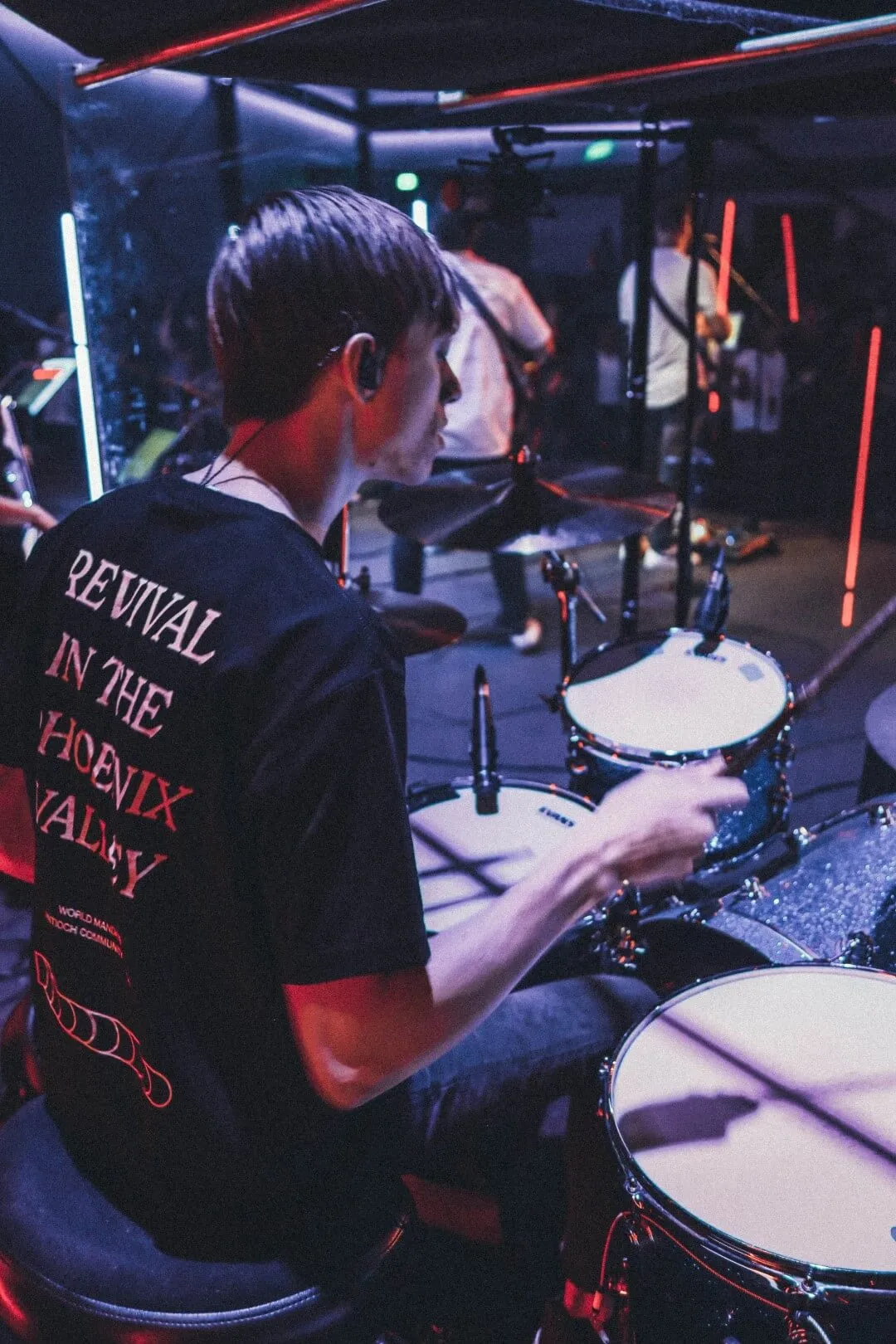
If you have been considering learning how to play drums, or your kid is begging for their first drum kit to beat on, you’re in the right place. It’s never too late or too early to learn drums (I’ve taught ages 3 and 73), but it’s important to know how to start. It can be overwhelming to see all the hardware of a drum kit laid out and not know what all those knobs and screws are for!
Here’s the good news: the best place to start is with whatever you already have. As you get into a regular rhythm of practicing, you can expand your gear gradually, so you can save money and make sure drums are right for you before diving into the deep end!
As you start your drumming journey: start simple, commit to short daily sessions, and only upgrade gear after consistency is established.
Gear
Starting Point
Drum sticks
Getting started is super easy: the only drum-specific thing you need to buy is a pair of drum sticks. The most standard size for drum set is 5A, so I would start there. Smaller hands may prefer 7A’s; if sticks feel heavy or light to you, that’s okay, this is just a starting point.
Pillow + Chair
With drum sticks in hand, you need something to hit (without causing too much damage). Pull up a chair next to your bed or couch, put a pillow flat in front of you, and you have the ultimate drummer’s hack to saving money. You can start practicing your technique right away:
- Sit upright.
- Relax your shoulders.
- Let your elbows hang naturally.
- Rotate from the wrist, not the elbow.
Free Metronome
Now, it’s not just about muscles, but also timing: simply Google “Metronome” and one will appear right there at the top of the results.
For your first exercise, put the metronome at 80 BPM. Hit the pillow in time with the beat - start with 8 in a row on each hand, swapping back and forth. If you want a printable version of this exercise, Snare Science has a solid Eight on a Hand PDF.
Core gear I recommend
Practice Pad & Stand
Once you’ve got your hands around holding drum sticks correctly and playing simple rhythms, you’ll probably want to hit something that feels a bit more like a real drum. The most popular practice pad is the Evans RealFeel, but there are countless options. The biggest difference you’ll immediately feel is rebound. Just like a real drum, practice pads take the energy you’re applying through the drum stick and return it right back to you - the drum stick will bounce right back up after you play a note. Controlling rebound is, really, the secret to all drumming, so don’t be discouraged if it feels awkward or difficult! It’s slightly different on all drums and practice pads, so you’ll learn over the years how to refine your touch based on your playing surface.
With a real practice pad under your sticks, pay even more attention to your technique: your sticks should meet the surface at about 10 degrees down, so move your seat height and pad height appropriately.
Dedicated Metronome
It’s definitely worth it to invest in a real, professional metronome, because you will use this for countless hours in your practice. An app will do - I’ve used Tempo Advance by FrozenApe for over 15 years; it is very good. For a dedicated hardware metronome, a BOSS Dr. Beat is all you need.
When You’re Ready
Drum set
This is the goal! Once you feel comfortable with your hands playing simple rhythms, the whole world of drumming opens up to you. Obviously a drum set is also the first substantial financial investment on this list. A beginner acoustic drum set can be priced in the range of $600-800 - though you may find cheaper sets, you’ll want to pay close attention to what you’re buying. Cheap sets will likely be made of poplar, or not have the wood type listed. If you can spring for birch shells, do it: birch is a popular wood type even for professional kits, and you will hear the difference in tuning. If you want a deeper breakdown of shell woods and their tonal differences, Yamaha has a strong explainer here: A Brief Guide to Drum Tonewoods. My first kit was an orange Mapex M, these days I think the equivalent is the Mapex Mars Birch shell pack.
Electronic drum sets are great if you live in an apartment or need low-volume, and the entry point is slightly lower. I have never owned an electronic kit, so I’ll point you to Sweetwater’s recommendations here.
Cymbals
Cymbals also have a steep dropoff in quality if you go too low. The number one thing to look for is material, again: do not buy brass cymbals. They sound awful, break quickly, and feel different to play. I recommend starting with B8 cymbals; they are bronze like professional cymbals, but with a slightly different alloy composition. My first cymbals were Zildjian ZBT’s, and the modern equivalent would be the Zildjian I family (also check out Sabian B8X or Paiste PST5).
Hardware
I encourage you once more to search for quality in your drum hardware. Double-braced stands are a must for stability while playing and durability if you need to move your kit often. There are a lot of options here; look at reviews if you’re in doubt or overwhelmed.
With all that acquired, you’re ready to jam out!
Resources worth your time
Rudiments
The Vic Firth Education section has a lot of great content, including the famous rudiments. Print them out and keep them on hand wherever you practice!
Stick Control by George Lawrence Stone
This is the bible of drumming. You can find it here: Stick Control by George Lawrence Stone. If you buy only one book in your first year of drumming, let it be this.
If you don’t know how to read music notation, now’s the time to learn!
Drum Lessons
In-person, one-on-one lessons are the best way to learn any instrument or skill. If you’re in Phoenix, AZ, I can be your teacher!
There is also a wealth of knowledge from the best drummers of our time available on the internet. I love MikesLessons.com (from Mike Johnston) or Drumeo; both have free content on YouTube and additional paid content on their sites (Method or Foundations learning tracks are a good place to start). Stephen’s Drum Shed has great beginner content: how to practice, technique, and basic coordination.
Go drum right now
The best way to become a better drummer is by drumming! Play along to music, play exercises along to a metronome, or just play whatever comes to mind. Put down your phone, pick up some sticks, and get playing.